About the SOLAIRIA Study
This is a randomized, double-blind, placebo-controlled study to evaluate the investigational drug GB-0895 and see how well it works to reduce serious asthma attacks in adults and adolescents with severe asthma, when used along with other treatments.
What is the medicine in the study?
GB-0895 is an investigational drug, a monoclonal antibody that targets thymic stromal lymphopoietin (TSLP), which helps drive airway inflammation in asthma.
In this study, it is given by injection under the skin every six months and used as an add-on to participants’ usual asthma medicines; some participants will receive placebo. It is being studied in adults and adolescents with severe, uncontrolled asthma.
How does it work?
GB-0895 works by binding to and blocking TSLP, a protein that helps start and amplify airway inflammation. By preventing TSLP signaling, it may reduce downstream inflammatory activity in the airways. In this study, it is given by injection under the skin every six months and used as an add-on to participants’ usual asthma medicines; some participants will receive placebo.
Watch the short mechanism of action (MOA) video to learn more.
Details
Program Design
The SOLAIRIA program includes two Phase 3, randomized, double-blind, placebo-controlled studies in adults and adolescents with severe, uncontrolled asthma. The main goal is to see whether GB-0895 reduces the rate of serious asthma attacks over 52 weeks, compared with placebo, when used along with participants’ usual asthma medicines. Researchers will also assess lung function, symptom control, and health-related quality of life.
Participants are randomly assigned to receive GB-0895 or placebo; neither participants nor the study team will know which treatment is given until the study ends (double-blind). This design helps ensure unbiased and reliable results.
Each study includes screening, one year of treatment, and about nine months of follow-up; some participants may be able to join an optional open-label extension after the first year.
Early Proven Results
In a Phase 1 study of 100 patients with mild to moderate asthma, a single injection of GB-0895 reduced airway inflammation for at least six months. Inflammation was measured through the presence of immune cells such as blood eosinophils and cytokines, as well as exhaled nitric oxide, a common signal of inflammation and asthma.
Unlike most current biologics, which require injections every 2-4 weeks (and some every 8 weeks), GB-0895 could offer durable asthma control with only two planned doses per year. Importantly, GB-0895 may be effective across patients regardless of their baseline eosinophil levels, which could make it accessible to more people than many existing treatments.
These findings, presented at the European Respiratory Society (ERS) International Congress in September 2025, suggest GB-0895 has the potential to reduce treatment burden while maintaining lasting asthma control. Because GB-0895 targets TSLP, a well-validated driver of asthma, and showed durable activity with a favorable safety profile in Phase 1, Generate is moving directly into Phase 3 studies with the support of the FDA and EMA.
Study Timeline
| Time Period | Description | ||||
|---|---|---|---|---|---|
| 2 Weeks | Screening Period
|
||||
| 4 Weeks | Run-In Period
|
||||
| 52 Weeks | Treatment Period
|
||||
| Option 1Weeks 52-90 | Follow-Up Period
|
||||
| Option 2Weeks 52-142 | Open-Label Extension
|
||||
|
|||||
Eligibility
Participation in the SOLAIRIA Study may be possible for you or someone you care about if you/they:
- Are 12 to 80 years old
- Have had an asthma diagnosis for more than 2 years
- Are on medium to high doses of inhaled corticosteroids (ICS).
- Have required corticosteroids at least twice over the last 12 months to control asthma
- Are willing to attend regular study visits and follow study procedures
- Meet all other study requirements, as confirmed by the study doctor
Resources
Patient Flyer
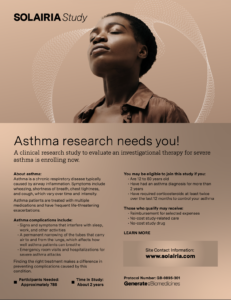
Designed to help introduce the SOLAIRIA Study to potential participants. This flyer can be used to support patient conversations or be shared with individuals who may want to learn more about participating.
Study Overview
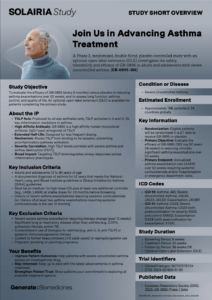
Designed as a quick reference for healthcare professionals, this overview supports study awareness, patient identification, and referral conversations.
ERS 2025 Poster
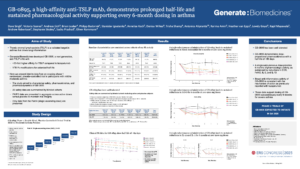
Generate’s presentation of Phase 1 GB-0895 data from ERS 2025, including study design, safety, pharmacokinetics, biomarker results, and conclusions supporting further evaluation in severe asthma.
ERS 2025 Late-Breaker Presentation
Generate’s ERS 2025 late-breaker presenation on Phase 1 GB-0895 results, including the study rationale, dose cohorts, safety findings, pharmacokinetic profile, and sustained reductions in key inflammatory biomarkers.